About
I'm a computer-vision and robotics engineer based in Heilbronn, Germany, working at the intersection of deep reinforcement learning, perception, and production AI. My path runs from control theory through robotics research into shipping real-time ML systems — and points toward a PhD in learning-based autonomy.
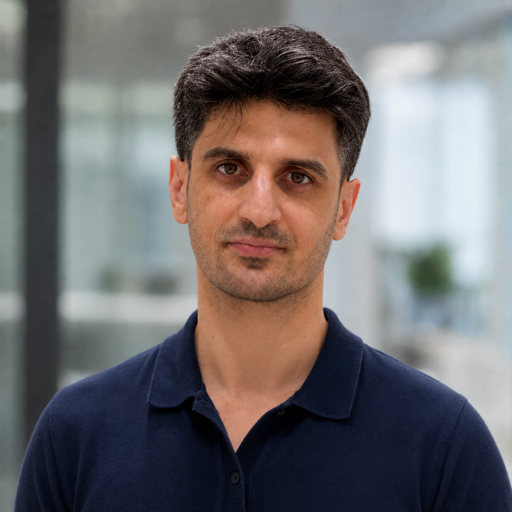
From control theory to production AI.
Applied AI Software Engineer
Building VMask, an AI privacy-masking system for remote desktop sessions: real-time OCR, computer vision, GPU inference, backend services and Linux remote-desktop infrastructure.
AI/ML & Full-Stack Innovation Intern
Two AI logistics projects — route optimization and predictive container-pickup planning — delivered as ML models, backend logic and a full-stack prototype.
Computer Vision Engineer (Intern)
Object detection, anomaly detection and OCR for industrial applications using Python, Docker, Azure, Kubernetes and CI/CD.
Software Engineering
Intensive, project-based systems programming — C, C++, Shell, Docker and AI integration.
M.Sc. Electrical Engineering — Control Systems
Thesis: continuous control of nonholonomic mobile-robot navigation with deep RL (PPO, DDPG); vision-based autonomous navigation.
B.Sc. Electrical Engineering — Control Systems
Thesis: mentor-robot position control via forward kinematics and mobile sensor data. Top-3 graduate.
Instrumentation Engineer
Calibration, monitoring, sensor integration and control-loop tuning for instrumentation systems.
Tools of the trade.
AI / ML
- PyTorch
- TensorFlow
- Scikit-learn
- OpenCV
- Hugging Face
- LangChain
Robotics & RL
- ROS
- Gazebo
- LiDAR
- PPO / DDPG / SAC
- GAIL / IRL / MPC
- PointNet / DGCNN
Systems
- C / C++
- Python
- Shell
- Linux
- CUDA / TensorRT
- MATLAB
DevOps / Web
- Docker
- Kubernetes
- Azure Pipelines
- Git
- gRPC
- HTML / CSS / JS
Awards & achievements.
Top Performer — Audi XL2 DeepRacer RL Competition
Among the top participants in a virtual & on-site reinforcement-learning competition for autonomous navigation.
Ranked 67th — National Master's Entrance Exam
Top 0.2% of 30,000+ participants nationwide.
Exceptionally Talented Student
Admitted to Iran University of Science & Technology without an entrance exam.
Top-3 Graduate, B.Sc.
University of Isfahan.